


 Date:2026.10.29
 Views: Loading


Larger formats can simplify an energy container, but they also concentrate heat and make manufacturing variation more consequential. The evolution of utility-scale cells is best assessed through system-level effects, including integration, efficiency, cycle performance, thermal behavior, quality control, and the evidence required for utility-scale ESS projects.
Larger Cells Reduce Repeated Components
A higher-capacity cell can reduce the number of units connected in a pack or complete system for the same energy target. Fewer units may mean fewer busbar joints, welds, BMS channels, fasteners, and individual sensing points. That simplification can support a denser layout and reduce assembly work. It does not eliminate packs, cooling, protection, or controls.
Instead, it changes their geometry and the amount of energy associated with each component or fault boundary. Component reduction affects reliability mathematics as well as construction. Every connector, weld, sensor, and communication channel is another item that can require inspection or create a failure mode.
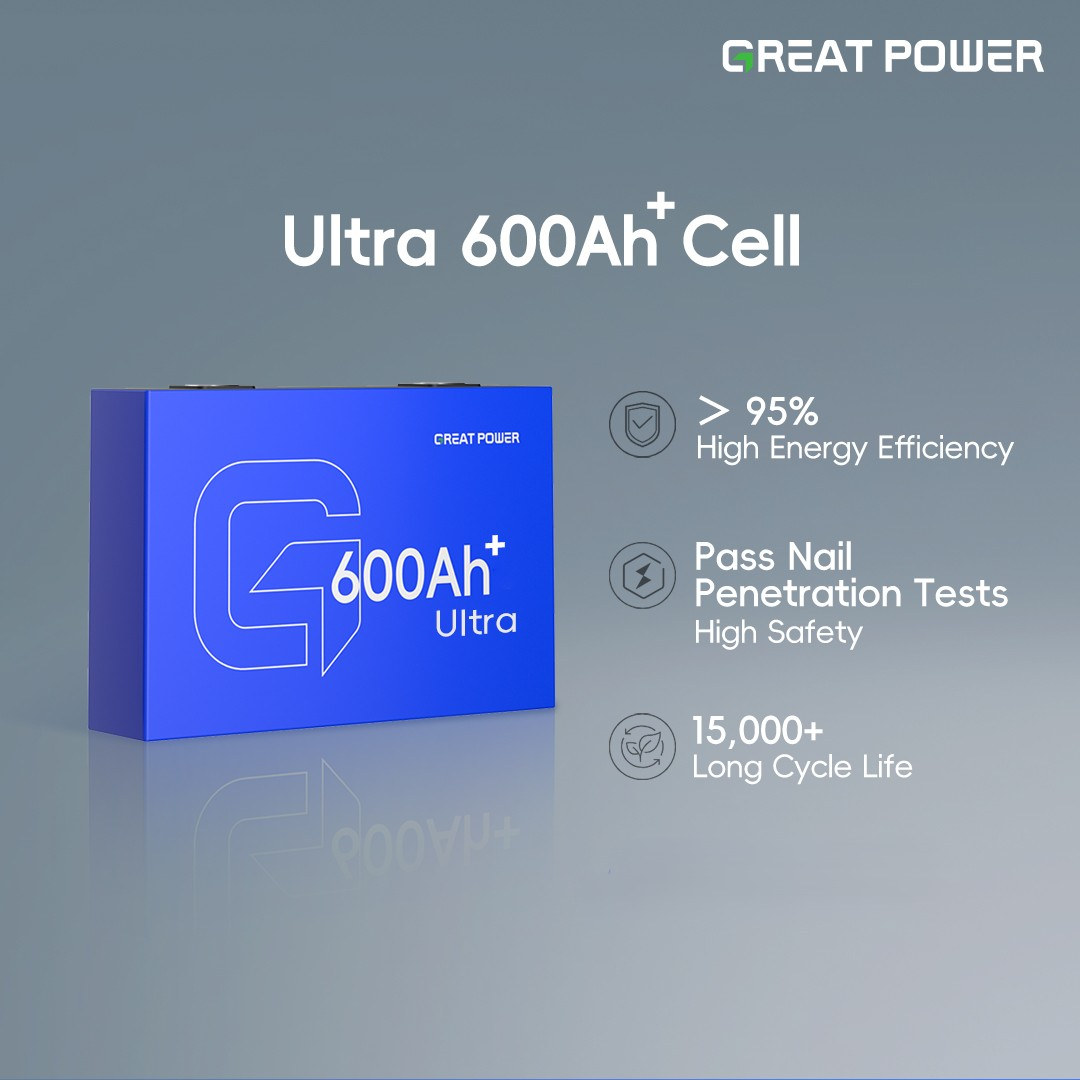
Reducing their count can simplify diagnostics and inventory, but the remaining components carry more energy and responsibility. Designers must consider whether fewer parallel elements alter redundancy, isolation, replacement size, or fault impact. Cell choice changes both the bill of materials and the way the plant tolerates an unavailable unit. Great Power describes a 587 Ah large-capacity LFP cell for utility-scale systems.
Our 587 Ah LFP cell is specified with more than 10,000 cycles and energy efficiency above 95% at 25 °C. The cell platform is also used in a 6.25 MWh container configuration, although cell-level performance and complete-system characteristics must be evaluated separately. Separately, our Ultra 588 Ah platform is used in Max-20HC-6250, combining liquid-cooled packs with a six-level cabinet safety protection system. At utility-scale, cell capacity matters only within an energy container that coordinates compatible cooling and protection systems.
Heat Paths Grow More Important with Format
Increasing cell capacity changes the distance and route through which heat must travel. Local temperature variation can influence electrochemical behavior, aging, and protection limits. The 587 Ah platform uses a honeycomb carbon cooling structure to create multiple heat-dissipation paths.
Magna-UTL liquid-cooled outdoor systems are specified to maintain cell temperature differences below 2 °C. This performance figure applies to the stated product range and should not be extended automatically to all large-format battery systems. The cooling structure and the system loop address different stages of heat transfer, so both remain relevant as the format becomes larger.
Thermal-runaway evaluation also moves with system design. UL9540A testing is used to characterize and control propagation in the specified arrangement. A larger cell may reduce component count, but the energy associated with one unit makes isolation, venting, sensing, enclosure behavior, and suppression evidence no less important.
Energy storage utilities need the tested cell, pack, and system boundaries to match the configuration proposed for deployment. Rate and duration add another constraint. A utility project may charge or discharge at different fractions of rated power, and heat generation changes with that profile.
Cycle targets also depend on depth of discharge, temperature, rest periods, and end-of-life criteria. Efficiency and cycle data give a large cell specification meaning when their test conditions approximate the intended duty. Otherwise, the apparent improvement may not survive translation from the test point to the energy container schedule.
Manufacturing Precision Carries More Weight
Fewer cells per megawatt-hour do not reduce the importance of consistency. A dimensional, coating, alignment, or weld defect affects a larger share of system capacity when each cell stores more energy. Great Power describes more than 300 process-control points for the large cell and 100% automated optical inspection for electrode alignment, coating defects, and dimensional accuracy.
Those controls connect cell design with repeatable manufacturing; production scale by itself cannot establish reliability. Scale-up introduces timing as well. A design may perform well in development while production equipment, inspection limits, or material handling are still being stabilized.
Process capability, yield, sampling, and change control show whether the same geometry can be repeated at volume. Energy storage utilities depend on that repeatability because a single project can contain many cells from multiple production lots. Market-ready evolution requires cell performance and manufacturing control to mature together.
System Integration Determines the Net Benefit
Large cells can reduce repeated hardware and help a 20-foot system reach higher capacity, but the advantage depends on what happens to cooling, service access, redundancy, and transport. A smaller component count may simplify assembly while making individual replacements less granular.
Dense integration can reduce footprint while increasing the need for precise thermal and structural design. A system comparison needs component counts, efficiency, availability, maintenance strategy, and end-of-life requirements alongside nominal cell capacity. Those dependencies make net system evidence more useful than cell capacity alone.
Our Great Power work on 587 Ah and Ultra 588 Ah platforms links electrochemistry with pack cooling, cabinet safety, manufacturing inspection, and complete-system design. For energy storage utilities, cell development must answer the operating and integration pressures of large projects. Progress is demonstrated when a larger format produces a verified system-level gain, not merely when one cell carries a higher capacity label.
 Consulting & Services

 Great Power
