


 Date:2026.10.30
 Views: Loading


These requirements interact: extra capacity can add mass, high discharge can add heat, and a smaller enclosure can reduce cooling or service space. Vehicle duty and the mechanical envelope jointly define a custom lithium ion battery for a scooter, motorcycle, or balance bike.
Mechanical and Thermal Conditions Meet on the Road
A moving vehicle exposes the pack to vibration, shock, water, dust, and repeated temperature changes. Mechanical restraint must protect cells and connections without creating harmful stress. Heat from high current needs a path away from the cells, while cold conditions can reduce available power and charging capability.
Placement near the motor, controller, or enclosed body panels also changes the thermal environment. A custom lithium ion battery has to be assessed in the installed vehicle, not only on a bench, under the vehicle’s combined electrical, mechanical, and environmental duty.
An electric two-wheeler traction pack requires a rechargeable battery system designed for repeated charge-and-discharge cycles. Primary cells are not a substitute for that rechargeable system. This distinction keeps battery chemistry and charging requirements clear during vehicle design.
Charging controls, connector design, and cycle expectations all depend on the rechargeable nature of the vehicle pack. The primary lithium battery cannot define a rechargeable traction pack. Repeating primary lithium battery does not establish charging, cycling, or protection requirements; the vehicle specification must directly state rechargeable chemistry and limits.
Range and Acceleration Create Separate Electrical Loads
Energy capacity largely determines how long the vehicle can operate between charges, while power capability determines how strongly it can respond at a given moment. Average commuting speed, stops, hills, payload, motor rating, controller limits, and regenerative behavior shape both values. A route with repeated acceleration may stress current capability even when total distance is moderate.
Range estimates also change with temperature, riding style, tire condition, and usable state-of-charge limits. Voltage establishes compatibility with the motor and controller, but the pack must maintain that voltage under load. Cell resistance, connection design, and state of charge influence voltage sag during acceleration.
Discharge rate expresses current relative to capacity and must be evaluated with heat generation and cycle targets. Great Power offers secondary products that support discharge above 5C or up to 10C depending on the application. Engineers can consequently match different power profiles without forcing one vehicle specification across every platform. Charging creates a second operating profile.
Available charger power, desired charge time, cell temperature, and the vehicle's daily schedule determine the charging rate. Faster charging may require tighter thermal control and a narrower permitted temperature window. The pack controller must enforce voltage and current limits throughout the charge. Both the riding profile and the return-to-service schedule shape the custom lithium ion battery.
Cell Format Shapes the Pack Envelope
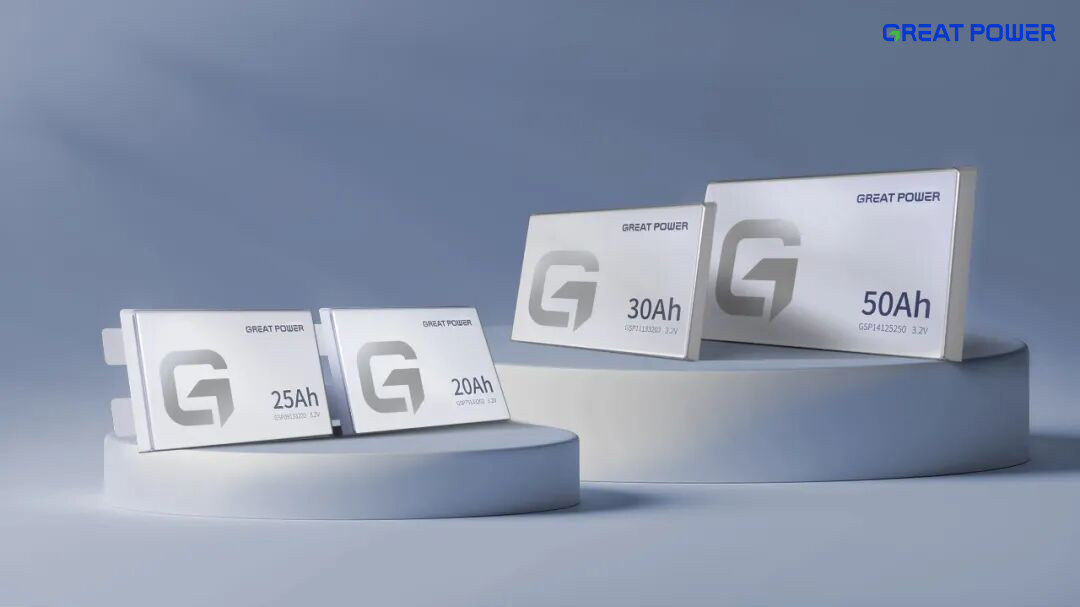
Cylindrical cells provide defined metal enclosures and repeatable dimensions, while pouch cells offer a different route to using available space. Pack design then determines cell orientation, structural support, electrical grouping, cooling, sensing, and protection. Our secondary-battery technologies include cylindrical and pouch formats, high-rate discharge, fast-charging, high-voltage, and low-temperature designs.
The correct combination depends on the vehicle's geometry and intended performance. For two-wheeler applications, we select cell dimensions according to the available frame space, required pack capacity, electrical configuration, and thermal-management needs.
For vehicle work, our HOME large-cylinder platform is designed for two-wheeled vehicles alongside outdoor power, residential storage, HEV systems, and 12V/48V starting power. The platform reflects five years of focused large-cylinder research built on more than two decades of battery-development experience. Series connections raise voltage, while parallel connections add capacity and current capability.
The resulting topology changes the number of welds, sensing points, and possible isolation groups. Cell matching matters because one weak group can reach a voltage limit before the rest of the pack. Mechanical packaging must then preserve electrical clearances and access while fitting the frame. These relationships turn cell selection into a complete pack architecture.
Customization Continues into Production Evidence
Great Power lists two-wheelers and electric balance bikes among our consumer-battery application fields. Across 10 global facilities, advanced automation supports hundreds of models; thousands of molds provide dimensional starting points for varied custom programs.
Those resources support dimensional and performance options, but the approved vehicle design still needs controlled materials, tooling, assembly, inspection, and traceability. UN38.3, IEC62619, RoHS, IATF, ISO9001, and ISO14001 appear among the listed certifications supporting our consumer-battery portfolio.
Their scope and applicability must be matched to the proposed product and destination. Vehicle developers can then review range, peak power, voltage, charge time, temperature, mechanical space, protection, and production evidence as one design set. Effective customization joins the vehicle duty cycle with a cell platform that can be validated and manufactured consistently.
 Consulting & Services

 Great Power
