


 Date:2026.10.29
 Views: Loading


Even two systems with the same nominal megawatt-hours can produce different economic results if their efficiency, thermal behavior, degradation, or integration needs differ. A consistent lifecycle boundary provides a basis for comparing energy storage system costs. Expenses omitted from a low equipment quote usually reappear later during site construction, commissioning, maintenance, or long-term operation.
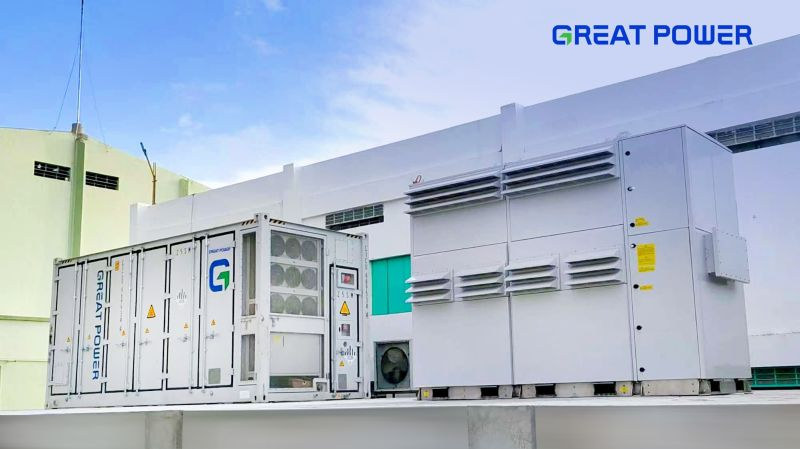
Cooling and Integration Shift Cost Between Stages
Thermal architecture changes both initial equipment and long-term operating considerations. Liquid cooling adds pumps, channels, controls, and service requirements, yet tighter cell temperature uniformity can support lifecycle performance in demanding or dense installations. Air cooling uses mature equipment and is positioned as a lower-cost alternative in Great Power's product range. Integration creates another exchange.
The Max-20HC-5000 uses a 20-foot GP container and lists a 50% increase in energy density, which can affect footprint and site work. Max-20HC-3440 is described as highly integrated, simply scalable, and compatible with third-party SCADA and cloud EMS. The total cost of a great power battery project depends on how these characteristics change civil work, commissioning, controls, maintenance, and available space.
Availability translates operating interruptions into economic consequences. Planned maintenance consumes labor and may temporarily reduce capacity; unplanned outages can affect contracted service or missed energy-shifting opportunities. Remote diagnostics, spare-part strategy, software access, and response responsibility belong in the cost boundary even when they are not priced as battery hardware.
Those items need project-specific commercial inputs in a great power battery proposal; a technical datasheet cannot supply the missing prices and contractual assumptions. The same rule applies to warranties: their value depends on coverage, exclusions, response process, and the operating conditions required to keep them valid.
Efficiency Converts Technical Losses into Operating Cost
Every charging and discharging cycle loses some energy, and small percentage differences accumulate across repeated operation. Operating rate also matters because efficiency can change with power. Our Max-20HC-5000 achieves battery-cell efficiency of at least 96%, with DC-side round-trip efficiency of 96% at 0.25P and 95% at 0.5P.
Our Max-20HC-3440 offers DC charge-and-discharge efficiency above 95%. These values show why a cost model needs the rate and system boundary attached to every efficiency input. Lost electricity cannot be sold, shifted, or used by the load, so our Great Power performance data belongs inside the economic calculation for ess energy storage.
Power Capacity and Duration Define the Base System
Project cost starts with the service requirement. Power determines how quickly energy must move, while capacity determines how long the required output can continue. Peak shaving, renewable shifting, grid support, and backup duties create different power-to-energy ratios and cycle patterns.
State-of-charge limits, reserve requirements, auxiliary consumption, and expected degradation can increase the nominal capacity needed to deliver the contracted output. Nameplate capacity alone is an incomplete comparison basis.
Usable energy and operating duty reveal how a great power battery configuration will serve the project. Oversizing raises capital cost, while undersizing may reduce revenue, shorten support time, or require earlier augmentation.
Balance-of-system scope can be equally significant. Power conversion equipment, transformers, switchgear, protection, communication links, foundations, cabling, fire systems, and grid-connection studies may sit inside one proposal and outside another. Transport dimensions, lifting requirements, and commissioning tests also vary with product format.
A consistent estimate assigns every item to the supplier, integrator, contractor, or owner before comparing totals. Otherwise, an incomplete boundary can create apparent savings even though the underlying design is no less expensive. Contingency should be tied to unresolved interfaces instead of added as an unexplained percentage.
Service Life and Retained Energy Shape the Denominator
A lifecycle comparison needs the energy expected to be delivered over time, not only the years printed on a datasheet. The C&I solution lists a 15-year service life, at least 95.5% cell efficiency, at least 90% system efficiency under standard 25°C conditions, and 70% energy retention after 10 years.
Max-20HC-3440 also lists a 15-year design life and a 30% increase in battery lifespan. Assumptions about cycling, ambient temperature, operating window, downtime, and augmentation determine how those specifications enter a financial model. For ess energy storage, the denominator of lifetime cost shrinks when losses, degradation, or unavailable periods reduce delivered megawatt-hours.
Comparable scope and assumptions are prerequisites for a reliable cost conclusion. Each comparison needs identical duty cycles, energy prices, efficiency boundaries, degradation treatment, service period, installation items, and risk allowances. Our Great Power product data supplies several measurable inputs, but it does not replace site-specific prices or a project financial model.
Sensitivity analysis can then show which assumptions dominate the result and where additional engineering detail is worth more than a price reduction. A complete estimate connects technical behavior to cash flow and delivered energy. The lowest opening price can produce the more expensive outcome. The most economical option is the system that meets the required service at the lowest defensible lifecycle cost.
 Consulting & Services

 Great Power
